The $2 Billion Loan Ritesh Agarwal Took to Buy Back OYO
Table of Contents
To buy back a piece of the company he had founded, Ritesh Agarwal pledged the only piece of it he still owned.
In July 2019 he arranged a two billion dollar loan from Nomura, Mizuho and a third Japanese bank. The collateral was his remaining stake in OYO. Repayment fell due in three years, timed to a listing the company had not yet announced.
He was twenty-five years old.
Roughly $1.5 billion of it bought shares back from Sequoia, Lightspeed and Greenoaks. The investors he had spent seven years selling to.
To understand why a founder would take on personal debt at that scale to repurchase equity he had already sold, you have to start at a small shop in Rayagada, Odisha.
The Boy Who Sold SIM Cards
Ritesh Agarwal was born in November 1993 in Bissam Cuttack and raised in Titilagarh. His family ran a shop in Rayagada. Before he was twenty he was selling SIM cards there.
In 2011 he moved to Delhi for college. He did not finish.
What he did instead was travel and stay in budget hotels, and notice that no two of them were the same. A room booked in one town bore no relation to a room booked in another. There were no standards. There was no brand. There was only the gamble you took when you opened the door.
In 2012 he launched Oravel Stays, an aggregator of bed and breakfast accommodation. It raised ₹30 lakh through the Venture Nursery accelerator. It did not work particularly well.
Then, in May 2013, something happened that changes the arithmetic of a young founder's life. Agarwal won a Thiel Fellowship. He was nineteen. He was the first Indian and the first Asian resident to win it, one of around twenty selected from thousands of applicants worldwide. The grant was $100,000.
That same month, Oravel became OYO Rooms.
The idea had sharpened into something much harder and much better. Rather than list budget hotels, OYO would take them over. Standardise the linen. Fix the bathroom. Train the staff. Put one name above every door so that a traveller in Rayagada and a traveller in Gurgaon booked the same promise.
It worked.
Five Years, One Billion Dollars
By September 2018, five years after launch, OYO had raised a billion dollars.
Understand what that sentence contains. Every round of it bought something real. Rooms signed. Cities entered. Countries entered. Engineers hired. A brand built fast enough to matter before somebody else built it.
And every round of it cost something too, quietly, in a currency that does not show up in a press release.
By 2019 the founder of OYO owned roughly nine percent of OYO.
That is not unusual. It is the ordinary mathematics of raising a billion dollars in five years. You cannot buy that much speed with anything other than ownership. Agarwal had traded the company away in exchange for the ability to build it, which is the trade almost every venture-backed founder makes.
The difference is what he did next.
He Bought It Back
In July 2019 Agarwal moved to buy roughly $1.5 billion of shares back from Sequoia, Lightspeed, and Greenoaks, with a further $500 million earmarked for primary investment. The total facility was $2 billion, arranged with Nomura, Mizuho, and a third Japanese lender.
The collateral was his own stake. The repayment horizon was three years, timed to an IPO the company expected to complete inside that window.
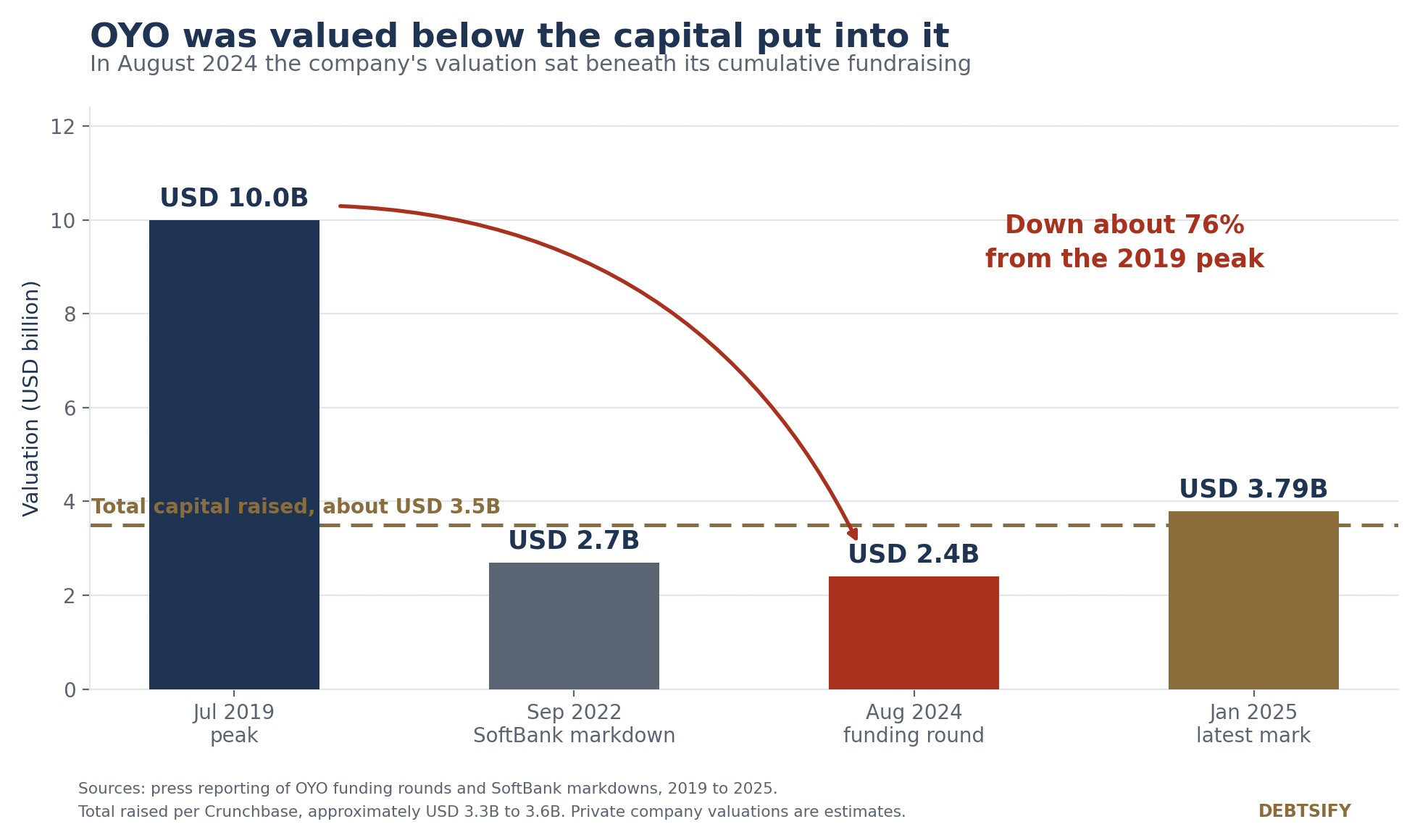
The transaction valued OYO at $10 billion, double its previous mark.
Read that sequence again, because it is the whole story compressed into a single move. A founder sells equity for seven years to fund growth. The growth works. The company becomes valuable. And then, to get his ownership back, he has to borrow two billion dollars at the highest valuation the company has ever carried, secured against the very shares he is trying to protect.
He bought at the top. Not because he was foolish, but because the top is when a buyback becomes necessary and expensive at the same time. Equity you sell cheaply gets repurchased dearly. That is the direction the trade runs, always.
The Spreadsheet in Tokyo
Then the market turned.
In September 2022 SoftBank, OYO's largest shareholder, cut its internal valuation of the company to $2.7 billion. Roughly seventy-three percent of the paper value evaporated in a line item.
No negotiation preceded it. No board fight. An investor holding the largest position revalued the asset in its own reporting cycle, for its own reasons, and every other shareholder's paper worth moved with it.
The founder who had borrowed two billion dollars against shares priced at a $10 billion valuation watched those shares get marked at a quarter of it. He was not in the room. There was no room.
It went further. In August 2024 OYO raised $175 million at a valuation of about $2.4 billion, down roughly seventy-six percent from the 2019 peak.
At that mark, OYO was worth less than the total capital that had been put into it across its entire life.
And the loan still had a repayment date.
In March 2025, the business press reported that OYO was accelerating its listing plans as its founder's debt repayment deadline approached. The IPO was no longer only a corporate milestone. It had become a personal one.
The Part Nobody Writes About
Here is what usually gets left out of this story, because it is less dramatic than the fall.
OYO kept working.
In FY2024 it posted its first profit after tax, ₹229 crore, on the back of eight consecutive quarters of positive adjusted EBITDA. Adjusted EBITDA that year reached ₹877 crore, up from ₹277 crore the year before.
FY2025 delivered net profit of ₹245 crore.
Then the nine months to December 2025 delivered ₹748 crore. Roughly three times the entire previous year, in three quarters.
In June 2026, SEBI cleared the listing. The parent company, renamed Prism, has filed for a ₹6,650 crore issue. Every rupee of it is a fresh issue. Neither Agarwal nor SoftBank is selling a single share.
The company that was written off is going public, profitable, raising money for the business rather than cashing out the people who built it.
What He Owns Now
The draft prospectus gives the number.
Ritesh Agarwal holds 6.59% directly and 20.12% through RA Hospitality Holdings. Combined: 26.71%.
SoftBank holds 40.04%.
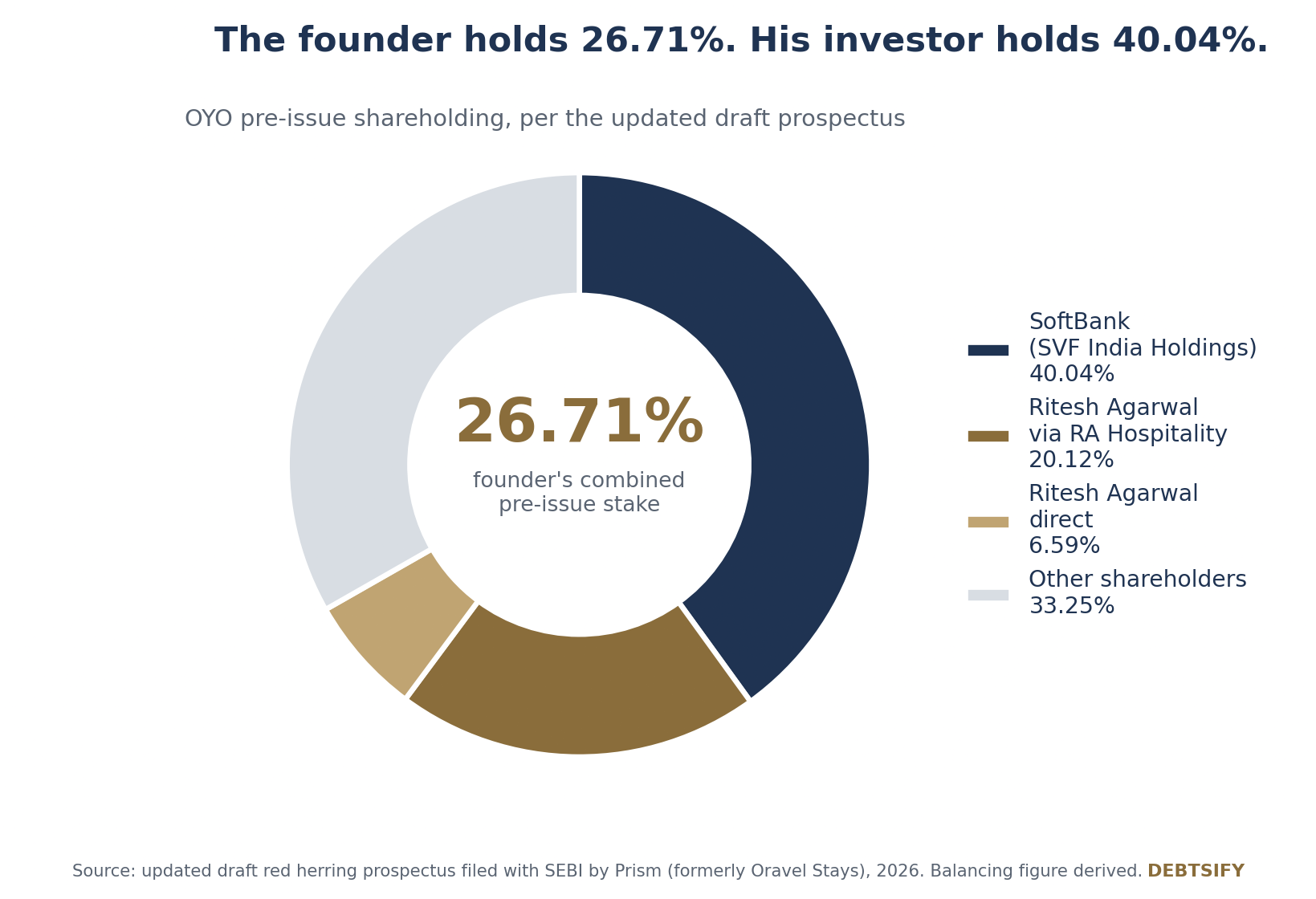
He is not the largest shareholder in the company he started at nineteen. He borrowed two billion dollars to get to twenty-six percent, and twenty-six percent is where he arrived.
There is no villain here. SoftBank's capital built OYO. Without it there is no international expansion, no scale, no company to write about. The category demanded balance-sheet depth that no lender would ever have provided, and equity was largely the right instrument for what OYO was trying to do.
But the receipt is worth reading.
Two Lessons, and They Point in Opposite Directions
Most tellings of this story land on one lesson. There are two, and holding both is the only honest position.
The first is about equity. It is the most expensive capital there is, and the bill arrives late. Agarwal did not feel the cost in 2014 or 2016. He felt it in 2019, when getting back to a meaningful stake required two billion dollars of personal debt. Ownership sold at a seed valuation is bought back at a growth valuation, if it can be bought back at all. Usually it cannot.
The second is about debt, and it cuts the other way. The buyback loan was not badly conceived, but it was structured against an event rather than against cash flow. It assumed an IPO inside three years. When markets moved and the IPO slipped, the repayment date did not move with it. Debt tied to a hoped-for event is a bet. Debt tied to money the business actually generates is a tool.
Put them together and you get something more useful than "raise equity" or "avoid dilution."
Match the instrument to the need, and match the repayment to the cash flow.
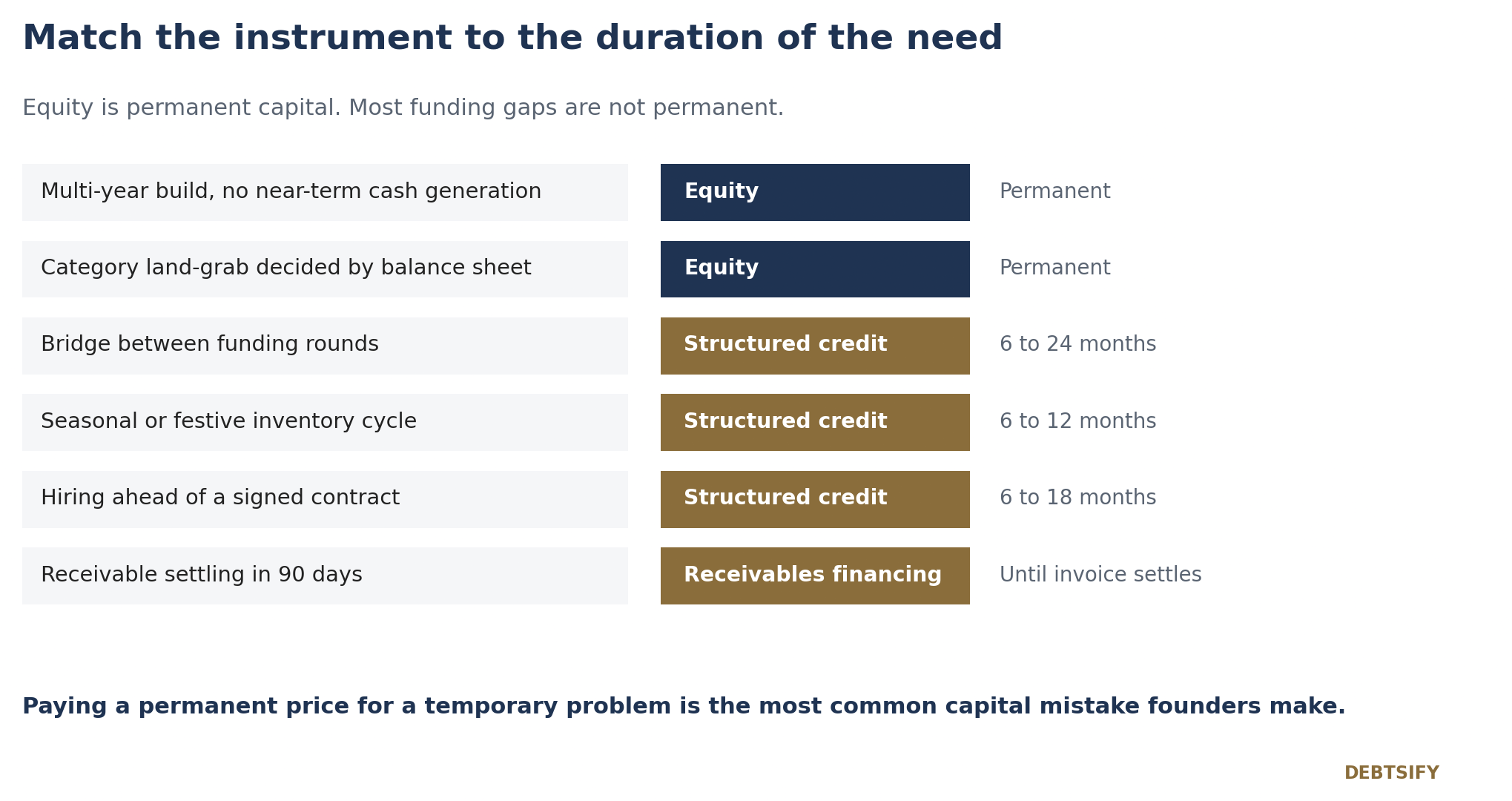
Equity is permanent capital. It should fund permanent things: a multi-year build, a category land grab, a business that will not generate cash for years.
Most funding gaps are not permanent. A festive inventory cycle is not permanent. A receivable settling in ninety days is not permanent. A bridge between rounds is not permanent. Hiring against a signed contract that invoices in six months is not permanent.
Funding a temporary problem by selling ownership means paying a permanent price. And the price is not visible on the day you pay it. It shows up years later, in a prospectus, as a percentage.
Where Debtsify Sits
We exist for the requirements that should never have become equity conversations.
Debtsify is a private structured-credit and bridge-financing partner for revenue-generating Indian companies. We arrange facilities of ₹5 crore to ₹100 crore that are fully non-dilutive. No shares, no warrants, no conversion rights, no board seats, no collateral.
- What we underwrite: Revenue quality, gross margin, customer concentration, and how reliably you collect. Not projections, not your asset base. Triage runs on two documents: a one-page corporate snapshot and six months of operating bank statements.
- How the timeline works: Fit assessment in roughly two hours. Triage status in roughly four. An Investment Committee meeting where terms are agreed in the room. Disbursal typically by Day 4.
- What we are not: Not a bank. Not registered with the RBI as an NBFC. Not the lender ourselves. We arrange and structure capital from third-party providers including RBI-registered NBFCs, alternative investment funds, family offices, and other private lenders.
- What we will tell you plainly: This costs more in interest than a bank term loan. If your timeline is comfortable and you have collateral, take the bank's money. And if your business cannot service the repayment in a flat case, credit is the wrong answer and equity is the right one.
The one thing we will never do is structure a facility against an event you are hoping for. We size it to the gap, and we shape repayment around the cash flow that closes it.
The Short Version
- Total Raised: OYO raised approximately $3.3 billion to $3.6 billion across roughly 18 to 22 rounds since 2013. The frequently repeated figure of $9.6 billion confuses capital raised with peak valuation.
- The $2B Buyback Loan: In July 2019 Ritesh Agarwal arranged a $2 billion facility from Nomura, Mizuho and a third Japanese bank to buy back shares from Sequoia, Lightspeed and Greenoaks, pledging his own stake as collateral.
- Valuation Trajectory: OYO's valuation went from about $10 billion in July 2019, to $2.7 billion in September 2022, to about $2.4 billion in August 2024, before recovering to roughly $3.79 billion.
- Financial Status: The company is now profitable. Net profit was ₹245 crore in FY2025 and ₹748 crore in the nine months to December 2025.
- Current Ownership: Agarwal holds 26.71% pre-issue. SoftBank holds 40.04%.
Frequently Asked Questions
How much did OYO actually raise?
Approximately $3.3 billion to $3.6 billion across roughly 18 to 22 rounds since 2013, according to funding databases. The widely quoted $9.6 billion figure confuses capital raised with valuation. OYO's peak valuation was near $10 billion in July 2019, following the founder's share buyback.
Why did Ritesh Agarwal borrow $2 billion?
To buy back roughly $1.5 billion of OYO shares from Sequoia, Lightspeed and Greenoaks, with about $500 million for primary investment. Seven years of equity fundraising had reduced his stake to around 9%. The facility was arranged with Nomura, Mizuho and a third Japanese lender, secured against his existing holding.
Is OYO profitable now?
Yes. FY2024 was its first profitable year with profit after tax of ₹229 crore. FY2025 delivered ₹245 crore. In the nine months to December 2025, net profit reached ₹748 crore, roughly three times the full prior year. SEBI cleared the company's listing in June 2026.
How much of OYO does the founder own?
The updated draft prospectus shows 6.59% held directly and 20.12% through RA Hospitality Holdings, a combined 26.71% before the issue. SoftBank, through SVF India Holdings, remains the largest shareholder at 40.04% on a fully diluted basis. Neither is selling in the offering.
What should founders take from this?
That equity is permanent capital and should fund permanent needs, and that debt should be repaid from cash flow rather than from an event you are hoping for. OYO's category genuinely required equity. The mistake most founders make is using it by default for temporary gaps.
Ready to explore structured funding options?
Connect with Debtsify today to discover how custom venture debt and non-dilutive bridge capital can fuel your growth without equity dilution.